and what they used to call 'word-processing software'
Feb 18, 2026
All right. I give in; I admit defeat.
Whatever I say to recommend dipping pens — however ridiculous that is — or fountain pens and physical pages made of paper, you’re likely to default to the laptop and its busy screen.
Most writers work on laptops most of the time. I’m guessing that’s statistically true — and maybe it’s not. Maybe there’s proof it’s still handwriting.
Laptops are the most convenient, portable means of production of writing. And with cloud backups, their loss or theft doesn’t result in the loss of all the work on them, unlike manuscripts that exist in one place at one time.
I still recommend you have two external hard drives and keep one of them in a different location to your laptop. Swap these hard drives home and away every couple of months, even if you have iCloud, Dropbox, OneDrive, or another server service. At some point I expect these clouds to go down, taking most of the world’s family photographs with them.
With your laptop you will be able to work in a café or library just as well as you do at home. As long as there’s Wi-Fi, your research can be as unlimited as the internet.
External physical reference works — a dictionary, slang dictionary, thesaurus, grammar guide, encyclopedia, gazetteer, almanac — all the lovely books I physically have to my right-hand side are diffused into search answers or AI requests. What can I do for you today?
Distraction. Time sump. Rabbit hole. Etcetera.
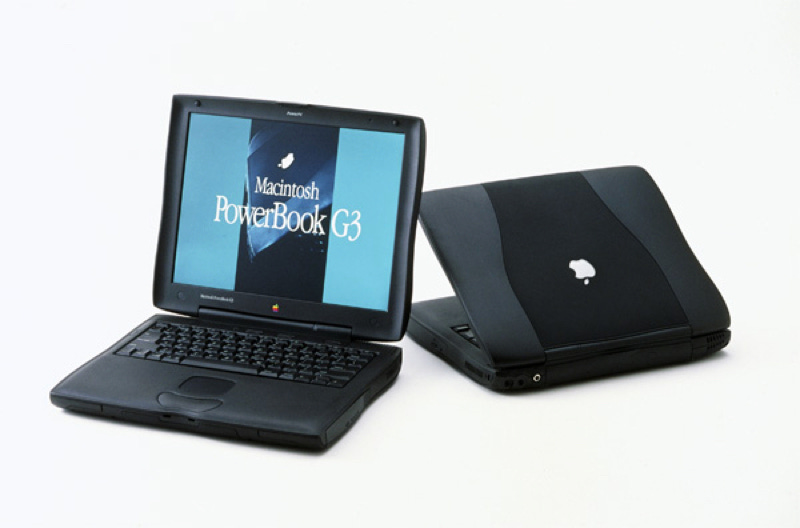
The keyboards of laptops are not great for extended periods of typing, although you may have become expert at ignoring this fact. MacBook Airs are fine, but the last laptop I truly thought beautiful was the black PowerBook G3 Pismo. (Took me ten minutes to look that up.)
I don’t know why Apple stopped making matte black laptops at that point in the history of design. Maybe they suddenly started hating Goths.
Now I’m going to talk a bit about word-processing software. It sounds incredibly old-fashioned to call it that, but unless you want to call it Word for something, that’s what it is.
I would guess that for most writers their laptop is their most invisible means. How often, though, whilst word-processing, do they discover something they can’t do?
For writing a New Yorker story, it’s fine. For more modernist — though I might say experimental — prose, a writer might need something like text-design software, which a laptop could handle just as well. This way a word can be placed just about anywhere on the page. The header, footer, and margins will need to be shooed away. A letter can be in any colour the screen can generate.
I used greyscale in Notes for a Young Gentleman, a novel I wrote, to indicate writing in pencil. And there are colour-coded letters in Only Revolutions. And maybe you can think of other novels or short stories that have coloured writing — blue, pink, green letters.
Most writers, as far as I can tell, seem happy enough with black and white.
Letters can also be inverted or put at nuanced angles. But Lewis Carroll — Charles Dodgson — and his publisher and printer were able to cope with the tale of a mouse. And Laurence Sterne’s imagination was in no way limited by conventional text.
Digression here — I’m not sure if it’s a grumpy one.
The bigger limitation, however, is human social imagination. Ever since the first Pixar films came out — at least since Toy Story (1995) or maybe Monsters, Inc. (2001) — it has been theoretically possible, if not in terms of actual budget and computing power, to control every single pixel of the big screen.
This means that everything seeable, every vision of which human eyes are capable, could be created and projected. And yet, although I’ve seen delightful and mischievous digital stories, I have hardly ever witnessed anything new or visionary or mind-expanding that’s been made digitally.
I’ve had my mind expanded by nature documentaries and things like that, but that’s not come out of human imagination.
Perhaps this is a fault in my sensibility. I have to go back to the earliest period of cinema — or cinematographs — to get a sense of unlimited possibilities. I’m thinking of stuff like The Skeleton Dance(1929).
For me, cinema is disappointment, twenty-four frames a second.
I’ll get in trouble for that.
Here’s the last bit.
The danger of word-processing software — and it is a real danger — is that we have no idea of the conventionalities it is coaxing us to accept. The paper A4 page is a field of possibilities. The screen, with its winking cursor and invisible or visible grid lines, is implicitly limiting.
Maybe you don’t agree. Let me know what you think.
Please like, share, and subscribe, and hope to see you soon.
Discussion about this episode
A Writer's Diary Podcast
Writing wisdom, advice and encouragement for every day of the year.
Join me (and help me) as I draft a writing manual 'On Drafting'.
I teach Creative Writing at the University of Southampton. If you're interested in mentoring or studying, I'm easy to find there.
Writing wisdom, advice and encouragement for every day of the year.
Join me (and help me) as I draft a writing manual 'On Drafting'.
I teach Creative Writing at the University of Southampton. If you're interested in mentoring or studying, I'm easy to find there.